Understanding better to build better dialogue: an exchange on the Dom community in Brussels
23 September 2026
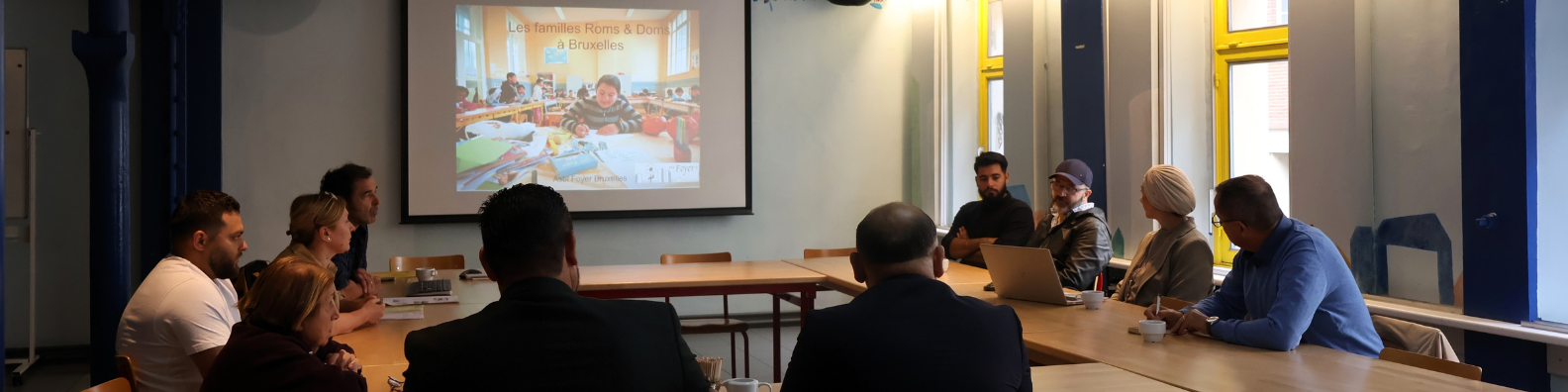
This week, Foyer’s Service for Roma and Travellers welcomed representatives of the Brussels-West police zone for an exchange on the Syrian Dom community living in Brussels.
The meeting also brought together a representative of Bruxelles Environnement and representatives of Roma communities. The aim was to better understand the cultural and social context of the Dom community, as well as the realities and ways of organisation of the different Roma communities present in Brussels.
This greater understanding should help the different stakeholders identify the most appropriate ways to engage with families, prevent tensions and foster dialogue.
Parc Bonnevie at the heart of the discussions
A significant part of the discussion focused on the current situation around Parc Bonnevie in Molenbeek.
Following several incidents in the park in 2025, the police had increased their presence in order to restore a safer environment. Today, the park is once again widely used by families and local residents. At the same time, Syrian Dom families have also started using the park as a place to meet and spend time together.
This situation has nevertheless led to some tensions. Concerns were raised about noise, the use of shared public spaces and compliance with the rules that apply in public parks. For some residents living immediately around the park, the situation also affects their own use of this space.
The discussions also placed these concerns in the context of the reality experienced by Dom families. For people who may sometimes live in very small or overcrowded homes, public spaces can provide an important place to meet, spend time with family and enjoy an outdoor environment.
At the same time, this use of the park can have concrete consequences for people living nearby. With the start of the new school year and the return to regular work routines, local residents want to be able to enjoy a quieter environment, particularly in the evening. Groups sometimes remain in the park after 10 p.m., with noise and activities that can be difficult to reconcile with everyday life in the neighbourhood. Cleanliness was also discussed, particularly when waste is left behind and subsequently has to be dealt with by the teams responsible for maintaining the park.
The challenge is therefore to find a balance between the need for access to outdoor space and respect for the people living around the park, as well as the rules that apply to this shared public space.
Understanding everyone’s realities
The meeting also highlighted the diversity of Roma communities in Brussels. The Syrian Doms are not organised around a single central organisation or institution that can easily communicate information to all families.
This presents a challenge when it comes, for example, to raising awareness about the rules governing the use of public spaces or communicating preventive messages. Foyer’s Service for Roma and Travellers shared its experience of mediation and the difficulties involved in identifying people who could act as trusted points of contact or intermediaries within the different families.
The Roma representatives present also shared testimonies about situations of stigmatisation and tensions that some communities may experience. These exchanges highlighted the importance of taking into account the realities experienced by different groups and avoiding reducing an entire community to a few problematic situations.
Preventing tensions through dialogue
Beyond identifying the issues, participants discussed ways of preventing tensions from escalating and improving coexistence in public spaces.
Respect for shared rules and for the neighbourhood is an essential part of this. Certain activities, such as cooking directly in public parks, are for example not permitted and can contribute to tensions with local residents.
Dialogue is equally important. This means being able to explain the rules, understand the habits and needs of the different people concerned, and identify the right channels for communicating directly with families.
The police also stressed that the aim is not to have to intervene regularly in public spaces to manage conflicts, but rather to work with the other stakeholders towards a situation in which everyone can find their place.
The meeting therefore provided a basis for further reflection on coexistence, inclusion and dialogue.
Getting to know one another better, understanding everyone’s realities and identifying the right people to engage with are all important steps towards creating shared public spaces where everyone can coexist with mutual respect.
Back
